


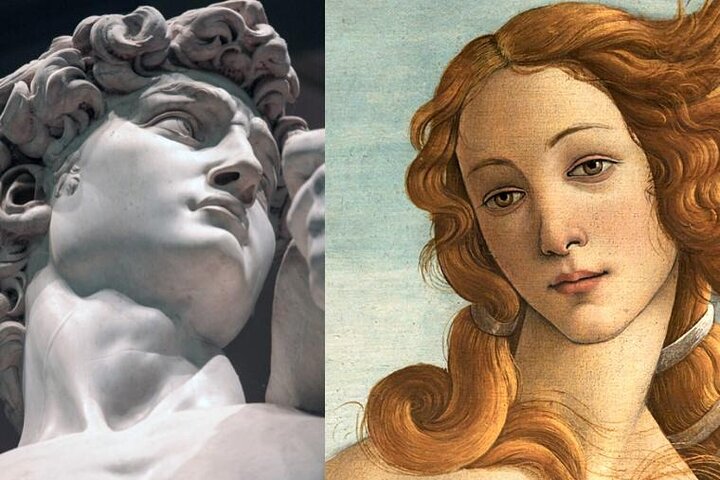


Accademia Gallery & David Tours: Michelangelo’s Masterpiece
Quick summary: The Accademia Gallery in Florence is home to Michelangelo’s David — the most famous statue in the world, and the single reason most visitors come. Beyond the David, the gallery holds Michelangelo’s unfinished Prisoners (or Slaves), a fine collection of Renaissance painting, and a museum of historic musical instruments. The gallery is small and intensely popular, so skip-the-line entry is essential in peak season, when queues run to hours. A short visit focused on the David takes about an hour, and a guide brings out the story behind the marble.
Accademia Gallery at a Glance
| Detail | Information |
|---|---|
| The main draw | Michelangelo’s David |
| Carved | 1501–1504, from a single block of marble |
| Height | 5.17 metres (17 feet) |
| Also holds | Michelangelo’s unfinished Prisoners; Renaissance paintings |
| Other collection | Historic musical instruments |
| Gallery size | Small — a focused visit |
| Crowds | Intensely popular; queues run to hours |
| Booking | Skip-the-line essential in peak season |
| Time needed | About 1–1.5 hours |
What Is the Accademia Gallery?
The Accademia Gallery (Galleria dell’Accademia) is the Florence museum that houses Michelangelo’s David, the most famous statue in the world.
While the David is the reason most people visit, the gallery is more than a single statue. It holds Michelangelo’s unfinished Prisoners, a notable collection of Renaissance painting, and a museum of historic musical instruments. But there is no pretending otherwise: the David is the centrepiece, and it draws visitors from across the world to this otherwise modestly sized gallery.
It is worth knowing that the Accademia is small compared with the Uffizi. A visit here is focused and relatively short, built around one overwhelming masterpiece rather than a vast collection.
Why Is Michelangelo’s David So Famous?
The David is famous because it is one of the supreme achievements of Western sculpture, and because its story is as remarkable as its appearance.
Michelangelo carved it between 1501 and 1504, from a single block of marble that other sculptors had already abandoned as flawed. He was in his twenties. The finished figure — 5.17 metres tall — depicts the biblical David in the moment before his fight with Goliath, tense and watchful, and its anatomical precision and psychological intensity have never been surpassed.
Standing before it in person is a different experience from any photograph. The scale, the detail of the veins and muscles, and the sheer presence of the marble are things reproductions cannot convey. This is where a guide adds most: the story of the flawed block, the political meaning the statue held for the Florentine republic, and the details of its carving turn an iconic image into a living achievement.
What Else Is in the Accademia?
Beyond the David, the gallery holds several things worth seeing.
Michelangelo’s Prisoners (or Slaves) — a series of unfinished figures that appear to be struggling to emerge from the raw marble. They line the hall leading to the David, and many visitors find them almost as compelling: they show Michelangelo’s method mid-process, the figure being “freed” from the stone.
Renaissance paintings — a fine collection of Florentine panel painting, including gold-ground medieval works and Renaissance altarpieces.
The museum of musical instruments — a collection including instruments from the Medici court, among them some of the earliest surviving pianos.
The Prisoners in particular reward attention, and a good tour uses them to build toward the David at the end of the hall.
Why Is Skip-the-Line Entry Essential?
The Accademia is small and intensely popular, and the combination produces some of the worst queues in Florence.
Because the gallery draws huge numbers to see a single statue, and because its capacity is limited, the queue for general admission regularly runs to hours in peak season. A skip-the-line ticket reserves your entry time and lets you walk in, which at this gallery is not a convenience but close to a necessity from spring through autumn.
This makes advance booking the single most important decision for an Accademia visit. On the busiest days, walk-up tickets can be unavailable entirely, so booking ahead is the difference between seeing the David and spending your afternoon in a line.
Do You Need a Guided Tour of the Accademia?
The gallery is small enough to see independently, so a guide is less about navigation here than at the Uffizi — it is about the story.
A guided tour brings out what makes the David extraordinary: the flawed marble block, the young Michelangelo, the political symbolism for republican Florence, and the technical mastery of the carving. It also gives the Prisoners their proper context as a window into Michelangelo’s method.
For visitors who want to understand the David rather than simply see it, a guide is well worth it. Those happy to look independently can do so with an audio guide, since the gallery is easy to navigate. Either way, the booking that matters most is the skip-the-line entry.
What Do Accademia Tours Cover?
A typical guided tour takes in:
1. Michelangelo’s David — the centrepiece, with its full story 2. The Prisoners — the unfinished figures and Michelangelo’s method 3. The Renaissance paintings — Florentine panels and altarpieces 4. The musical instruments, where the tour includes them 5. The political and historical context of the David and republican Florence
Because the gallery is compact, tours here are shorter and more focused than at the Uffizi, often paired with a wider Florence walking tour.
How Does the Accademia Compare to the Uffizi?
The two are Florence’s essential art museums, but they are quite different visits.
The Uffizi is vast — the world’s greatest Renaissance painting collection, needing 2–3 hours and rewarding a guide to navigate its scale.
The Accademia is small and focused — built around the David, seen in about an hour, with a guide adding story rather than navigation.
Most first-time visitors to Florence do both, ideally on separate visits or split across a day, and both require advance booking to avoid the queues. A common approach is a shorter Accademia visit for the David and a longer Uffizi visit for the paintings, each with skip-the-line entry.
Practical Tips for Visiting the Accademia
- Book skip-the-line entry in advance — essential in peak season.
- Allow about an hour, as the gallery is compact and focused.
- Don’t rush past the Prisoners, which lead up to the David.
- Go early or late to avoid the busiest periods.
- Consider a guide for the story behind the David, rather than navigation.
- Pair it with the Uffizi on a separate visit, both booked ahead.
- Note it is not the Duomo — the David is here, not in the cathedral.
Are Accademia Gallery Tours Worth It?
For any visitor to Florence, seeing Michelangelo’s David is close to non-negotiable — and doing so with skip-the-line entry, ideally with a guide, is the way to make it a great experience rather than a frustrating one.
The David alone justifies the visit. It is one of the supreme works of Western art, carved by a young Michelangelo from a block others had given up on, and its presence in person is something no reproduction prepares you for. Add the unfinished Prisoners, which reveal how Michelangelo worked, and the visit becomes a genuine encounter with the greatest sculptor of the Renaissance.
The practical necessity is the booking. The Accademia’s queues are among the worst in Florence precisely because so many come for a single statue, and skip-the-line entry is essential in peak season — the decision that most determines whether your visit is a pleasure. A guide is the optional extra that turns seeing the David into understanding it.
For the most famous statue in the world, in the city where it was carved, a booked and guided Accademia visit is well worth it — a short visit, but an unforgettable one.
Frequently Asked Questions
Michelangelo’s David is in the Accademia Gallery (Galleria dell’Accademia) in Florence. A common misconception is that it stands in the Duomo or in Piazza della Signoria — the statue in the piazza is a replica, while the original has been in the Accademia since 1873.
It is one of the supreme achievements of Western sculpture. Michelangelo carved it between 1501 and 1504 from a single block of marble that other sculptors had abandoned as flawed, when he was in his twenties. The 5.17-metre figure depicts David before his fight with Goliath, and its anatomical precision and psychological intensity have never been surpassed.
Yes, in peak season it is essential. The Accademia is small and intensely popular, and the queue for general admission regularly runs to hours, with walk-up tickets sometimes unavailable entirely on the busiest days. A skip-the-line ticket reserves your entry time and is the single most important decision for a visit.
Beyond the David, the gallery holds Michelangelo’s unfinished Prisoners (or Slaves), figures that appear to struggle out of the raw marble and reveal his method; a fine collection of Florentine Renaissance painting; and a museum of historic musical instruments, including some of the earliest surviving pianos from the Medici court.
About one to one and a half hours. The Accademia is small and focused compared with the Uffizi, built around the David rather than a vast collection, so a visit is relatively short. It is often paired with a wider Florence walking tour.
The Uffizi is vast — the world’s greatest Renaissance painting collection, needing 2 to 3 hours and rewarding a guide to navigate its scale. The Accademia is small and focused, built around Michelangelo’s David and seen in about an hour. Most first-time visitors do both, on separate visits, and both require advance booking to avoid the queues.