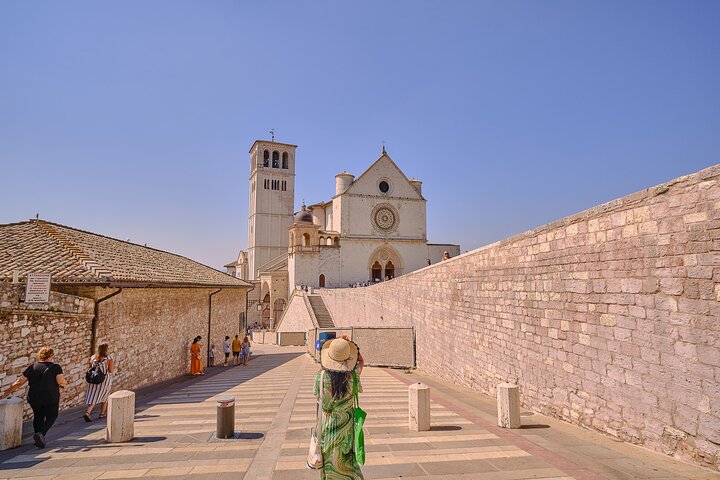
Assisi Day Trips from Florence: The Town of St Francis
Quick summary: An Assisi day trip from Florence takes you across into neighbouring Umbria to one of Italy’s greatest spiritual and artistic destinations — the hometown of St Francis, and one of the most important pilgrimage sites in the Christian world. Rising in pink-white stone on the slopes of Monte Subasio, Assisi is crowned by the magnificent Basilica of St Francis, whose walls are covered in celebrated frescoes by Giotto and other masters. Beyond its spiritual significance, it is a beautiful, serene medieval hilltown. Being in Umbria, it is a longer, full-day trip, but a deeply rewarding one.
Assisi Day Trips at a Glance
| Detail | Information |
|---|---|
| The town | Assisi, the town of St Francis |
| The region | Umbria (not Tuscany) |
| Its significance | A major Christian pilgrimage site |
| The great sight | The Basilica of St Francis |
| The art | Celebrated frescoes by Giotto and others |
| The setting | Pink-white stone on Monte Subasio |
| The character | Serene, spiritual, beautiful, medieval |
| Distance from Florence | In Umbria — a longer full-day trip |
| Best for | Pilgrims, art lovers, seekers of serenity |
What Is an Assisi Day Trip?
An Assisi day trip is an excursion from Florence across into neighbouring Umbria, to the hill town of Assisi — the birthplace of St Francis and one of the most significant spiritual and artistic destinations in Italy.
Assisi rises in beautiful pink-white stone on the slopes of Monte Subasio, a serene and lovely medieval hilltown crowned by the great Basilica of St Francis. As the home of St Francis (and St Clare), it is one of the foremost pilgrimage sites in the Christian world, drawing pilgrims and visitors from across the globe — but it is also a place of extraordinary art, its basilica adorned with some of the most celebrated frescoes in Italy, and a town of genuine beauty and tranquillity.
Because Assisi lies in Umbria, beyond Tuscany, it is a longer, full-day trip from Florence than the Tuscan destinations — but for its spiritual resonance, its art and its beauty, it is deeply rewarding.
Who Was St Francis and Why Is Assisi a Pilgrimage Site?
Assisi’s profound significance rests on St Francis of Assisi, one of the most beloved and important saints in Christian history.
Born in Assisi around 1181, Francis gave up a wealthy life to embrace poverty, humility and a love of all creation, founding the Franciscan order and becoming one of the most influential religious figures of the Middle Ages — revered for his devotion, his connection with nature and animals, and his radical simplicity. He is one of the patron saints of Italy. His fellow townswoman St Clare founded the related order of the Poor Clares.
Because Assisi is Francis’s birthplace, the scene of his life and ministry, and his burial place, it became one of the great pilgrimage destinations of Christendom — a status it holds to this day, drawing millions of pilgrims and visitors. This spiritual dimension gives Assisi a special atmosphere of serenity and devotion, and understanding St Francis is understanding why the town matters so deeply to so many.
What Is the Basilica of St Francis?
The great sight of Assisi is the Basilica of St Francis (Basilica di San Francesco) — a magnificent church that is both a major pilgrimage shrine and one of the greatest treasuries of medieval art in Italy.
Built from the 13th century over the tomb of St Francis, the basilica is famously composed of two churches, an Upper and a Lower, one above the other, and a crypt holding the saint’s tomb. Its walls are covered in celebrated frescoes by some of the greatest artists of the age — most famously a renowned cycle depicting the life of St Francis associated with Giotto, a landmark in the history of Western art, along with works by Cimabue, Simone Martini, Lorenzetti and others.
The basilica is thus doubly extraordinary: a holy shrine at the heart of the Franciscan world, and an artistic masterpiece whose frescoes mark a turning point in European painting. A UNESCO World Heritage Site, it is the reason many make the journey to Assisi, and it does not disappoint — moving for pilgrims and awe-inspiring for art lovers alike.
What Else Is There to See in Assisi?
Beyond the great basilica, Assisi is a beautiful and serene town with more to offer.
The Basilica of St Clare (Santa Chiara) — the pink-and-white church holding the tomb of St Clare, Francis’s follower.
The medieval streets — the tranquil, lovely lanes of pink-white stone climbing the hillside, a pleasure to wander.
The Piazza del Comune — the main square, with the ancient Roman Temple of Minerva (now a church) and medieval buildings.
The Rocca Maggiore — the hilltop fortress above the town, with commanding views.
The churches and hermitages — including sites associated with St Francis in and around the town, such as the Eremo delle Carceri hermitage on the mountain.
The views — sweeping panoramas over the Umbrian plain from the hillside town.
Even setting aside its spiritual significance, Assisi is a genuinely beautiful, peaceful and atmospheric medieval hilltown, its pink stone glowing in the sun, its streets serene — a lovely place simply to be, as well as a profound one to visit.
Is Assisi in Tuscany, and How Far Is It?
No — importantly, Assisi is not in Tuscany but in the neighbouring region of Umbria, to the south-east, and this shapes the trip.
Umbria, sometimes called “the green heart of Italy”, borders Tuscany and shares much of its beauty — rolling hills, medieval hilltowns, fine food and wine — but is a distinct region, and Assisi lies a fair way from Florence, making it a longer, full-day trip than most Tuscan destinations. An early start is sensible, and the day involves significant travel.
Because it is in Umbria, Assisi is sometimes visited as part of a wider exploration of the region, and can be combined with other Umbrian highlights (such as Perugia, the regional capital, or other towns) on Umbria-focused trips. For visitors based in Florence, an Assisi day trip is a chance to step beyond Tuscany into Umbria and experience one of Italy’s most significant and beautiful towns — well worth the longer journey for its unique spiritual and artistic riches.
Who Are Assisi Day Trips Best For?
Assisi day trips suit particular visitors.
Pilgrims and the spiritually minded — for the town of St Francis, one of Christendom’s great pilgrimage sites.
Art lovers — for the basilica’s frescoes, including the celebrated Giotto cycle, a landmark of Western art.
Those seeking serenity — for Assisi’s uniquely peaceful, contemplative atmosphere.
History lovers — for the medieval town and the story of St Francis.
Those wanting to see Umbria — for a step beyond Tuscany into the neighbouring region.
It suits those drawn to spiritual significance, great art, and serene beauty, and happy with a longer full-day trip into Umbria. Whether as a pilgrimage, an artistic journey, or simply a visit to a supremely beautiful and peaceful hilltown, Assisi rewards deeply — one of the most meaningful day trips available from Florence.
Practical Tips for Assisi Day Trips
- It’s in Umbria, not Tuscany — a longer, full-day trip.
- The Basilica of St Francis is the highlight — for the frescoes and the shrine.
- Dress respectfully for the churches (shoulders and knees covered).
- Allow time to wander the serene pink-stone streets.
- Consider an Umbria-focused trip to combine with Perugia or other towns.
- The atmosphere is contemplative — a different mood from the Tuscan towns.
- An early start helps, given the distance.
Are Assisi Day Trips from Florence Worth It?
For pilgrims, art lovers and anyone drawn to spiritual significance and serene beauty, an Assisi day trip from Florence is a deeply rewarding journey — well worth venturing beyond Tuscany into Umbria.
The appeal is profound and manifold. Assisi is the town of St Francis, one of the most beloved saints in history, and one of the great pilgrimage sites of the Christian world, imbued with a special atmosphere of serenity and devotion. It is home to the magnificent Basilica of St Francis, both a holy shrine over the saint’s tomb and an artistic masterpiece, its walls covered in celebrated frescoes including the renowned Giotto cycle that marks a turning point in Western art. And beyond all this, it is simply a beautiful, peaceful medieval hilltown of glowing pink-white stone, lovely to wander and to be in.
The one practical consideration is distance: Assisi lies in Umbria, not Tuscany, so it is a longer, full-day trip requiring an early start and significant travel — though its position also opens the door to exploring the beautiful neighbouring region.
For its spiritual resonance, its extraordinary art, and its serene beauty, an Assisi day trip is well worth it — one of the most meaningful and memorable excursions from Florence, and a highlight for pilgrims, art lovers and seekers of tranquillity alike.
Frequently Asked Questions
An Assisi day trip is an excursion from Florence across into neighbouring Umbria to the hill town of Assisi, the birthplace of St Francis and one of the most significant spiritual and artistic destinations in Italy. Rising in pink-white stone on Monte Subasio, Assisi is a serene medieval hilltown crowned by the great Basilica of St Francis, with its celebrated frescoes. Being in Umbria, it is a longer, full-day trip, but a deeply rewarding one.
St Francis of Assisi, born in the town around 1181, gave up a wealthy life to embrace poverty, humility and a love of all creation, founding the Franciscan order and becoming one of the most influential and beloved religious figures of the Middle Ages, and a patron saint of Italy. His fellow townswoman St Clare founded the Poor Clares. Because Assisi is Francis’s birthplace, the scene of his ministry and his burial place, it became one of the great pilgrimage destinations of Christendom, a status it holds today.
The Basilica of St Francis is a magnificent church that is both a major pilgrimage shrine and one of the greatest treasuries of medieval art in Italy. Built from the 13th century over the saint’s tomb, it comprises two churches, an Upper and a Lower, and a crypt. Its walls are covered in celebrated frescoes by the greatest artists of the age, most famously a renowned cycle on the life of St Francis associated with Giotto, along with works by Cimabue, Simone Martini and Lorenzetti. It is a UNESCO World Heritage Site.
No — Assisi is not in Tuscany but in the neighbouring region of Umbria, to the south-east. Umbria, sometimes called the green heart of Italy, borders Tuscany and shares much of its beauty but is a distinct region, and Assisi lies a fair way from Florence, making it a longer, full-day trip requiring an early start and significant travel. Because it is in Umbria, it can be combined with other Umbrian highlights like Perugia on region-focused trips.
Beyond the great basilica, highlights include the Basilica of St Clare (Santa Chiara), holding the tomb of St Clare; the tranquil medieval streets of pink-white stone; the Piazza del Comune with the ancient Roman Temple of Minerva; the hilltop Rocca Maggiore fortress with commanding views; churches and hermitages associated with St Francis, such as the Eremo delle Carceri on the mountain; and sweeping panoramas over the Umbrian plain. Assisi is a beautiful, peaceful hilltown as well as a profound one.
Pilgrims and the spiritually minded, for the town of St Francis; art lovers, for the basilica’s frescoes including the celebrated Giotto cycle; those seeking serenity, for Assisi’s peaceful, contemplative atmosphere; history lovers, for the medieval town and the story of St Francis; and those wanting to see Umbria beyond Tuscany. It suits those drawn to spiritual significance, great art and serene beauty, happy with a longer full-day trip into the neighbouring region.