



Medici History Tours Florence: The Dynasty That Made the Renaissance
Quick summary: The Medici were the banking family who ruled Florence for much of three centuries and, as the greatest patrons in history, funded the Renaissance itself. A Medici history tour follows their story across the city — from the Palazzo Medici Riccardi where they rose to power, to the Medici Chapels where they are buried beneath Michelangelo’s sculptures, taking in the Uffizi, Pitti Palace, Palazzo Vecchio and the churches they built. Rather than a single site, it is a thematic thread tying together the Florence the Medici created, told through the family who made it.
Medici History Tours at a Glance
| Detail | Information |
|---|---|
| Who they were | Florence’s ruling banking dynasty |
| Era | 15th to 18th century |
| Their role | The greatest art patrons in history |
| Rose to power under | Cosimo the Elder; peaked under Lorenzo the Magnificent |
| Key sites | Palazzo Medici Riccardi, Medici Chapels, Uffizi, Pitti |
| Their burial place | The Medici Chapels at San Lorenzo |
| Michelangelo link | The New Sacristy tombs |
| Format | A thematic tour across several sites |
| Best for | Understanding how Florence became Florence |
Who Were the Medici?
The Medici were the banking family who ruled Florence for much of the 15th to 18th centuries, and the greatest patrons of art in the history of the world.
They rose not as nobles but as bankers, becoming the wealthiest family in Europe, and from that wealth they came to dominate Florence — first informally, as its leading citizens, then openly, as its dukes and grand dukes. Along the way they funded the artists and buildings that made the city the birthplace of the Renaissance.
To understand the Medici is to understand Florence itself. Almost every great monument, gallery and church in the city bears their mark, which is why their story is best told not at one site but across the whole city they created.
Why Do the Medici Matter to the Renaissance?
The Medici matter because, more than anyone, they paid for the Renaissance.
Renaissance art did not appear from nowhere: it was commissioned, and the Medici were its greatest commissioners. Cosimo the Elder, who established the family’s power in the 15th century, funded Brunelleschi, Donatello and Fra Angelico. His grandson Lorenzo the Magnificent presided over a golden age, patronising Botticelli and giving the young Michelangelo a home in his household. Later Medici built the Uffizi, filled the Pitti Palace, and commissioned Michelangelo’s Medici Chapel tombs.
Their patronage was so vast that the collections they assembled became, on the family’s extinction, the core of Florence’s great museums — the Uffizi, the Pitti and more — bequeathed to the city on condition they never leave. A Medici tour explains this engine of patronage that drove the Renaissance.
What Sites Does a Medici Tour Cover?
A Medici history tour threads together the sites across Florence that tell the family’s story:
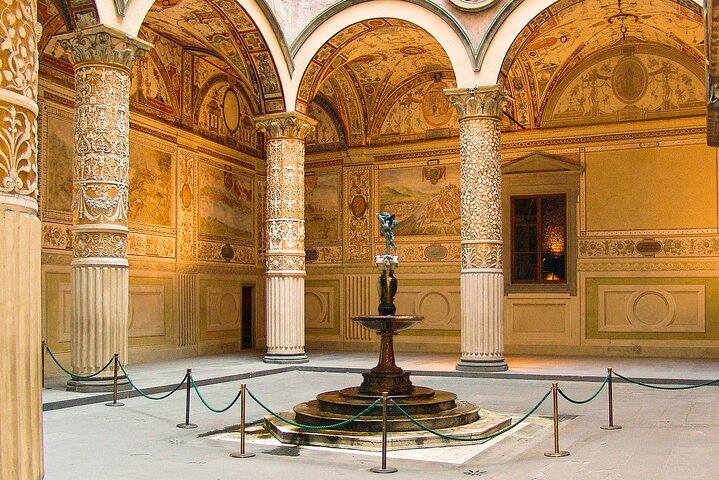
The Palazzo Medici Riccardi — the family’s first great palace, with the jewel-like Chapel of the Magi frescoed by Benozzo Gozzoli, showing the Medici among the procession.
The Medici Chapels at San Lorenzo — the family’s mausoleum, including the lavish domed Chapel of the Princes and Michelangelo’s New Sacristy with its famous tombs.
The Basilica of San Lorenzo — the Medici parish church, rebuilt by Brunelleschi as their family church.
The Palazzo Vecchio — the seat of power they occupied as dukes.
The Uffizi and Pitti Palace — their offices and residence, now holding the collections they amassed.
Together these trace the arc from banking family to grand dukes, and from private chapel to dynastic tomb.
What Are the Medici Chapels?
The Medici Chapels, attached to the Basilica of San Lorenzo, are the family’s mausoleum and one of the artistic highlights of any Medici tour.
They comprise two very different spaces. The Chapel of the Princes is a vast, sombre, octagonal hall lined entirely with dark marble and semiprecious stone — an overwhelming display of grand-ducal wealth where the later Medici are entombed. The New Sacristy was designed by Michelangelo, who created for it the celebrated tombs of two Medici dukes, with his allegorical sculptures of Day and Night, Dawn and Dusk — among the greatest works of his career.
To stand in the New Sacristy is to see Michelangelo’s architecture and sculpture conceived as a single whole, made directly for the family who had raised him. The chapels are the natural climax of a Medici tour: the dynasty at its most powerful, immortalised by the artist it had nurtured.
What Is the Story of the Medici?
The Medici story is one of the great sagas of European history, and a good tour tells it as a narrative rather than a list of sites.
It runs from Cosimo the Elder, who founded the family’s power through banking and shrewd patronage in the 15th century; through Lorenzo the Magnificent, poet, statesman and patron of the golden age; to the family’s temporary expulsion, the rule of two Medici popes, and their return as hereditary dukes and grand dukes of Tuscany. It takes in two Medici queens of France, the family’s slow decline, and the death of the last Medici, Anna Maria Luisa, who bequeathed their entire artistic inheritance to Florence.
Told well, it is a story of money, power, art, faith and family across three centuries — and it turns a series of monuments into a single, human drama.
How Is a Medici Tour Different From a Single-Site Tour?
The difference is that a Medici tour is organised around a story rather than a place.
A single-site tour — of the Uffizi, or the Palazzo Vecchio — goes deep on one location. A Medici tour connects several sites through the thread of the family, showing how each fits into the larger narrative: why the Uffizi exists, who is buried in the chapels, what the Palazzo Medici reveals about their rise. It trades the depth of one building for the sweep of the whole story.
This makes it ideal for visitors who want to understand how Florence became Florence — the forces and the family behind the art, rather than the art alone. It works well as a framework for a wider visit, giving coherence to sites you may also see individually.
Practical Tips for Medici History Tours
- Treat it as the story behind the sights, tying the city together.
- Include the Medici Chapels for Michelangelo’s tombs — a highlight.
- See the Palazzo Medici Riccardi and the Gozzoli chapel.
- Book chapel and museum entries where the tour includes ticketed sites.
- Pair it with the Uffizi or Palazzo Vecchio, which it explains.
- Allow a half-day for a multi-site Medici itinerary.
- Take a guide — the narrative is the whole point of this tour.
Are Medici History Tours Worth It?
For visitors who want to understand Florence rather than simply photograph it, a Medici history tour is one of the most rewarding ways to see the city — because the Medici are the key that unlocks everything else.
Almost every great sight in Florence connects to this one family: the Uffizi they built and filled, the Pitti they lived in, the Palazzo Vecchio they ruled from, the churches they funded, the chapels where they lie beneath Michelangelo’s sculptures. Seeing these as a connected story, rather than a checklist, transforms a visit — suddenly the whole city has an author, and its art has a reason.
The tour also reaches sites that reward it especially: the Medici Chapels, with Michelangelo’s New Sacristy tombs, are among the greatest things in Florence and central to the Medici story. And the narrative itself — bankers who became dukes and funded the Renaissance, ending with a last heiress who gave it all to the city — is a genuinely gripping tale.
For the story behind the sights, and for the sites that only a Medici tour brings together, it is well worth it — the thread that makes sense of Florence.
Frequently Asked Questions
The Medici were the banking family who ruled Florence for much of the 15th to 18th centuries and were the greatest patrons of art in history. They rose as bankers to become the wealthiest family in Europe, dominated Florence first as leading citizens and then as dukes and grand dukes, and funded the artists and buildings that made the city the birthplace of the Renaissance.
Because, more than anyone, they paid for it. Renaissance art was commissioned, and the Medici were its greatest commissioners. Cosimo the Elder funded Brunelleschi, Donatello and Fra Angelico; Lorenzo the Magnificent patronised Botticelli and gave the young Michelangelo a home. The collections they assembled became the core of Florence’s great museums, bequeathed to the city on condition they never leave.
A Medici history tour threads together the Palazzo Medici Riccardi with its Gozzoli chapel; the Medici Chapels at San Lorenzo, including Michelangelo’s New Sacristy tombs; the Basilica of San Lorenzo, their family church; the Palazzo Vecchio, their seat of power; and the Uffizi and Pitti Palace, now holding the collections they amassed. It is a thematic tour across several sites rather than one location.
The Medici Chapels, attached to San Lorenzo, are the family’s mausoleum. They comprise the Chapel of the Princes, a vast octagonal hall lined with dark marble and semiprecious stone, and the New Sacristy designed by Michelangelo, who created the celebrated tombs of two Medici dukes with his allegorical sculptures of Day, Night, Dawn and Dusk — among the greatest works of his career.
A Medici tour is organised around a story rather than a place. A single-site tour goes deep on one location; a Medici tour connects several sites through the thread of the family, showing how each fits the larger narrative — why the Uffizi exists, who is buried in the chapels, how the family rose. It suits visitors who want to understand how Florence became Florence.
The last of the direct Medici line was Anna Maria Luisa de’ Medici, who died in 1743. In her will she bequeathed the family’s entire artistic inheritance — the collections that fill the Uffizi, the Pitti and Florence’s other museums — to the city of Florence, on the condition that it never leave the city. This is why those treasures remain in Florence today.