
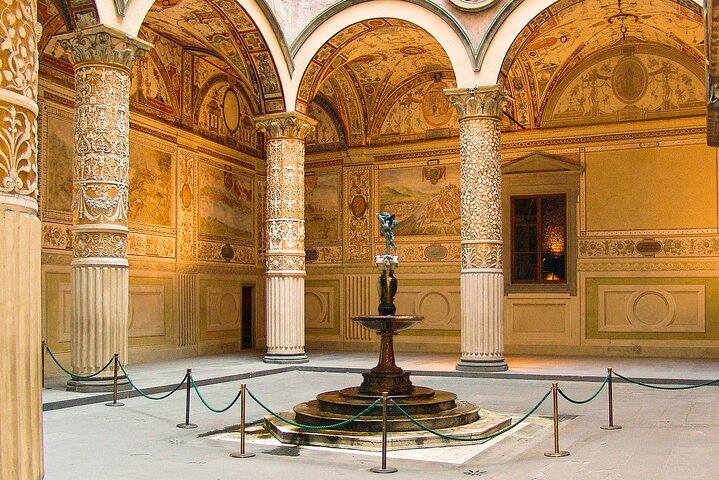

Santa Maria Novella Tours: Florence’s Great Fresco Church
Quick summary: Santa Maria Novella is the principal Dominican basilica of Florence, celebrated for its striking green-and-white marble facade — a landmark of Renaissance architecture by Leon Battista Alberti — and for one of the finest concentrations of fresco painting in the city. It holds Masaccio’s revolutionary Trinity, the first painting to use true linear perspective, alongside great fresco cycles by Ghirlandaio and Filippino Lippi. Nearby is the historic Officina Profumo-Farmaceutica, one of the world’s oldest pharmacies. It stands by the main railway station, making it many visitors’ first sight of Florence.
Santa Maria Novella at a Glance
| Detail | Information |
|---|---|
| What it is | The principal Dominican basilica of Florence |
| The facade | Green-and-white marble, completed by Alberti |
| Key masterpiece | Masaccio’s Trinity — first use of true perspective |
| Fresco cycles | By Ghirlandaio and Filippino Lippi |
| Also famous | Brunelleschi’s Crucifix; the Spanish Chapel |
| Nearby | The ancient Santa Maria Novella pharmacy |
| Location | By the main railway station |
| Entry | Ticketed |
| Best for | Renaissance frescoes and architecture |
What Is Santa Maria Novella?
Santa Maria Novella is the principal Dominican basilica of Florence, and one of the city’s most important churches.
Where Santa Croce is the great Franciscan church, Santa Maria Novella is the great Dominican one — the two mendicant orders each built a vast preaching church at opposite sides of the medieval city. Begun in the 13th century, it is a soaring Gothic basilica, and it served as the Dominicans’ base in Florence, a centre of learning and preaching.
For many visitors it is the first sight of Florence, since it stands directly beside the main railway station, which takes its name from the church. But it deserves far more than a passing glance: inside is one of the richest collections of fresco painting in the city, and its facade is a landmark in the history of architecture.
Why Is the Facade of Santa Maria Novella Famous?
The green-and-white marble facade of Santa Maria Novella is one of the most celebrated in Italy, and a milestone of Renaissance architecture.
The lower Gothic portion was begun earlier, but the upper facade was completed in the 15th century to a design by Leon Battista Alberti, the great Renaissance architect and theorist. Alberti unified the whole front with geometric harmony, adding the great scrolls that link the lower and upper storeys — a solution so elegant it was imitated for centuries.
The facade is a rare case of the Gothic and the Renaissance meeting in a single, harmonious front, and Alberti’s contribution makes it a key monument in the history of architecture as well as a beautiful sight. A guide brings out how the design works and why it mattered.
What Is Masaccio’s Trinity?
Inside the basilica hangs Masaccio’s Trinity, one of the most important paintings in the history of Western art.
Painted around 1427, it is celebrated as the first painting to use true linear perspective — the mathematical system, newly worked out in Renaissance Florence, for representing three-dimensional space on a flat surface. Masaccio painted an illusionistic chapel receding into the wall with such convincing depth that contemporaries were astonished, and the fresco became a foundation stone of Renaissance painting.
Standing before it, the illusion still works: the vaulted chapel seems to open into the wall. This single fresco makes Santa Maria Novella essential for anyone interested in the birth of the Renaissance, and it is exactly the kind of work whose significance a guide can unlock.
What Fresco Cycles Does the Church Hold?
Beyond the Trinity, Santa Maria Novella holds some of the greatest fresco cycles in Florence.
The Tornabuoni Chapel — the main chapel behind the high altar — is covered with a vast cycle by Domenico Ghirlandaio depicting the lives of the Virgin and St John the Baptist, filled with portraits of contemporary Florentines in contemporary dress, a vivid window onto the city of the 1480s. (The young Michelangelo trained in Ghirlandaio’s workshop.)
The Strozzi Chapel holds dramatic frescoes by Filippino Lippi.
The Spanish Chapel, off the cloister, is entirely covered with a striking 14th-century fresco cycle.
The church also holds Brunelleschi’s wooden Crucifix and Giotto’s Crucifix. Together these make Santa Maria Novella a gallery of Florentine fresco painting from the 14th to the 15th century, in its original architectural setting.
What Is the Santa Maria Novella Pharmacy?
A short walk from the basilica is the Officina Profumo-Farmaceutica di Santa Maria Novella, one of the oldest pharmacies in the world.
Founded by the Dominican friars of the basilica in the 13th century, and open to the public since the 17th, it still produces perfumes, soaps, herbal remedies and cosmetics using historic recipes, sold in beautiful frescoed and panelled rooms that are a sight in themselves. It is a working shop, not a museum, and free to enter and browse.
For many visitors it is a memorable counterpart to the church — the same Dominican community’s craft tradition, continuing after seven centuries. It features on some Santa Maria Novella and Oltrarno-area tours, and rewards a visit whether or not you buy.
How Does Santa Maria Novella Compare to Santa Croce?
The two great mendicant churches of Florence make a natural pairing, and each has its own character.
Santa Croce (Franciscan) is above all the burial place of the great — Michelangelo, Galileo, Machiavelli — a national pantheon with Giotto frescoes.
Santa Maria Novella (Dominican) is above all a church of frescoes and architecture — Masaccio’s revolutionary Trinity, Ghirlandaio’s cycles, and Alberti’s facade.
Both hold major art and both are ticketed, but their emphases differ: Santa Croce for tombs and Italian glory, Santa Maria Novella for the frescoes and the birth of Renaissance perspective. Visitors interested in the development of painting often find Santa Maria Novella the more rewarding; those drawn to the great figures of history prefer Santa Croce. Many see both.
Practical Tips for Visiting Santa Maria Novella
- Entry is ticketed, covering the basilica, chapels and cloisters.
- Find Masaccio’s Trinity, the birthplace of painted perspective.
- Study the Tornabuoni Chapel for Ghirlandaio’s portraits of 1480s Florence.
- Admire Alberti’s facade before going in.
- Visit the ancient pharmacy nearby, free to browse.
- Take a guide to unlock the significance of the frescoes.
- It’s by the station, so it’s easy to combine with arrival or departure.
Are Santa Maria Novella Tours Worth It?
For anyone interested in the birth and flowering of Renaissance painting, Santa Maria Novella is one of the essential churches of Florence — and a guided visit brings its treasures to life.
Its claim is exceptional. It holds Masaccio’s Trinity, the very painting that introduced true perspective and changed the course of Western art; Ghirlandaio’s fresco cycle peopled with the faces of 15th-century Florence; Filippino Lippi’s dramatic chapel; and Alberti’s facade, a landmark of Renaissance architecture. Few churches anywhere hold so much that is pivotal to the history of art.
Because entry is ticketed and the significance of works like the Trinity is not obvious to the eye, a guide adds real value — explaining how Masaccio’s perspective works and why it was revolutionary, and who peoples Ghirlandaio’s frescoes. The nearby ancient pharmacy adds a memorable, sensory coda to the visit.
Often a visitor’s first sight of Florence beside the station, Santa Maria Novella deserves to be far more than that. For the frescoes, the facade and the birth of the Renaissance, it is well worth the visit — and, paired with Santa Croce, completes the story of the city’s two great churches.
Frequently Asked Questions
Santa Maria Novella is the principal Dominican basilica of Florence, a soaring Gothic church begun in the 13th century. It is celebrated for its green-and-white marble facade completed by Leon Battista Alberti and for one of the finest concentrations of fresco painting in the city, including Masaccio’s Trinity. It stands beside the main railway station, which is named after it.
Masaccio’s Trinity, painted around 1427 in Santa Maria Novella, is celebrated as the first painting to use true linear perspective — the mathematical system for representing three-dimensional space on a flat surface. Masaccio painted an illusionistic chapel receding into the wall so convincingly that it became a foundation stone of Renaissance painting. The illusion still works before your eyes today.
The green-and-white marble facade is a milestone of Renaissance architecture. The lower Gothic portion was begun earlier, but the upper facade was completed in the 15th century to a design by Leon Battista Alberti, who unified the whole front with geometric harmony and added the great scrolls linking the storeys — a solution so elegant it was imitated for centuries. It is a rare case of Gothic and Renaissance meeting in one harmonious front.
The Tornabuoni Chapel behind the high altar is covered with a vast cycle by Domenico Ghirlandaio depicting the lives of the Virgin and St John, filled with portraits of 1480s Florentines. The Strozzi Chapel holds dramatic frescoes by Filippino Lippi, and the Spanish Chapel off the cloister is covered with a striking 14th-century cycle. The church also holds Brunelleschi’s wooden Crucifix.
The Officina Profumo-Farmaceutica di Santa Maria Novella is one of the oldest pharmacies in the world, founded by the Dominican friars of the basilica in the 13th century and open to the public since the 17th. It still produces perfumes, soaps and herbal remedies using historic recipes, sold in beautiful frescoed rooms. It is a working shop, free to enter and browse.
Santa Croce is the Franciscan church, famous above all as the burial place of Michelangelo, Galileo and Machiavelli. Santa Maria Novella is the Dominican church, famous for its frescoes and architecture — Masaccio’s Trinity, Ghirlandaio’s cycles and Alberti’s facade. Both are ticketed and hold major art; visitors interested in the development of painting often prefer Santa Maria Novella, those drawn to great historical figures prefer Santa Croce, and many see both.